A short report by Bernd Neeb, March 2026
The basic prerequisite for such a decision is, of course, an interest in astronomy and photography. This has existed for me for a good 60 years now. At that time, however, astrophotography for amateurs was quite complicated, time-consuming and also expensive. Therefore, for many years, the exploration of the sky for me was limited to observing the sky with binoculars and a 10 cm reflecting telescope from the department store.
By chance, I found the group "kosmos-os" a few years ago.
My own sky observations with our two binoculars are not very productive from our balcony due to the strongly brightened city sky. In addition, with age, vision also steadily deteriorates in the dark.
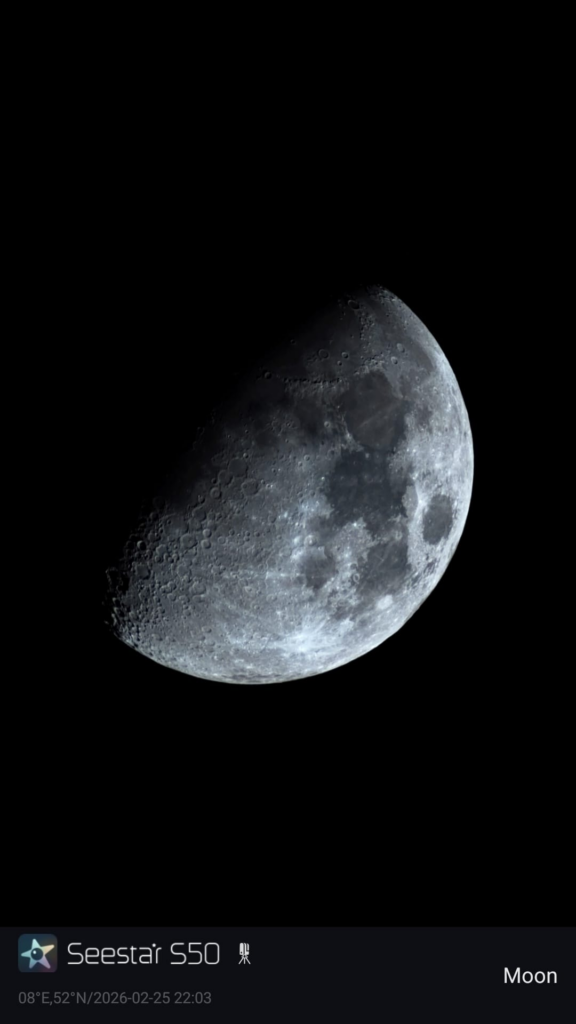
On the occasion of the international campaign "On the Moon again", in which kosmos-os was also active, I saw a Seestar S50 in action for the first time. A small, light black device with an inconspicuous 50 mm lens compared to the other telescopes. You couldn't see through it. However, you could look at the moon razor-sharp on the display of a tablet in peace. The Seestar immediately aroused my interest and the kosmos-os colleague to whom it belonged answered all my questions about the function of his telescope in detail and patiently. He also showed several images of celestial objects stored on the tablet, which he had already taken with it. Really very impressive pictures.
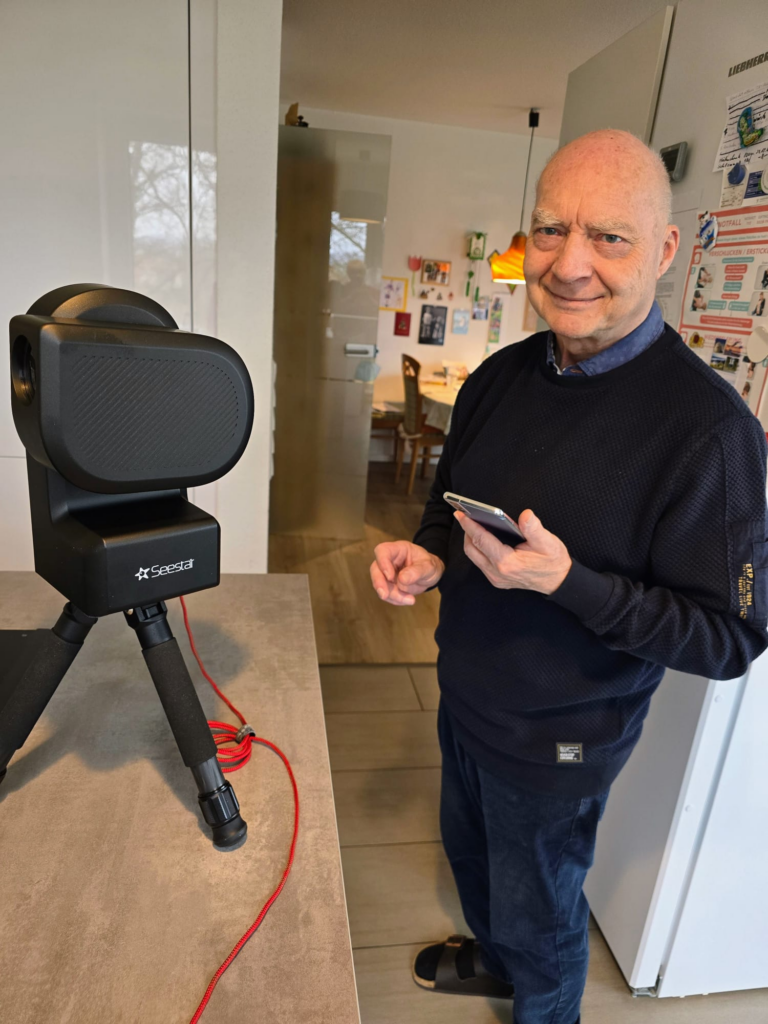
Handling is no more difficult than operating a smartphone, tablet or PC. It works largely automatically, so it can be used with almost no prior knowledge. In addition, it takes up little space in the home, can be easily taken with you on trips and it is financially affordable. In addition, it still works perfectly even at minus 8° Celsius, while you can control it comfortably from the warm room via WLAN.
After two more Seestar telescopes were purchased in our group in the last few months, I decided to buy the Seestar S50 despite the very limited visibility conditions (only a small section of the sky can be used from the balcony, strong light pollution plus the dust and haze of a big city) in order to finally enable optical sky observation again. The price in November 2025 was 559 euros. The delivery then took place one day before Christmas.
The commissioning based on the operating instructions went without any problems. It looked different with the first recordings. The lack of experience was very noticeable. In the first clear – but cold – nights, a number of objects could be photographed in good external conditions. Unfortunately, almost all pictures were lost because I used the battery of the Seestar far too much at the low temperatures. This led to an unintentional shutdown of the device (with 20% capacity according to the display in the app) with the result that all photos in the memory were lost because the hard drive had to be reformatted afterwards. On clear nights that followed, I often simply exposed too short. The recordings were then quite noisy. And I had to learn that at my location, all objects that are not at least 25 to 30 degrees above the horizon are not too easy to photograph. Since then, I have made sure to select the objects so that they are as high as possible above the horizon and a sufficiently long exposure is possible.
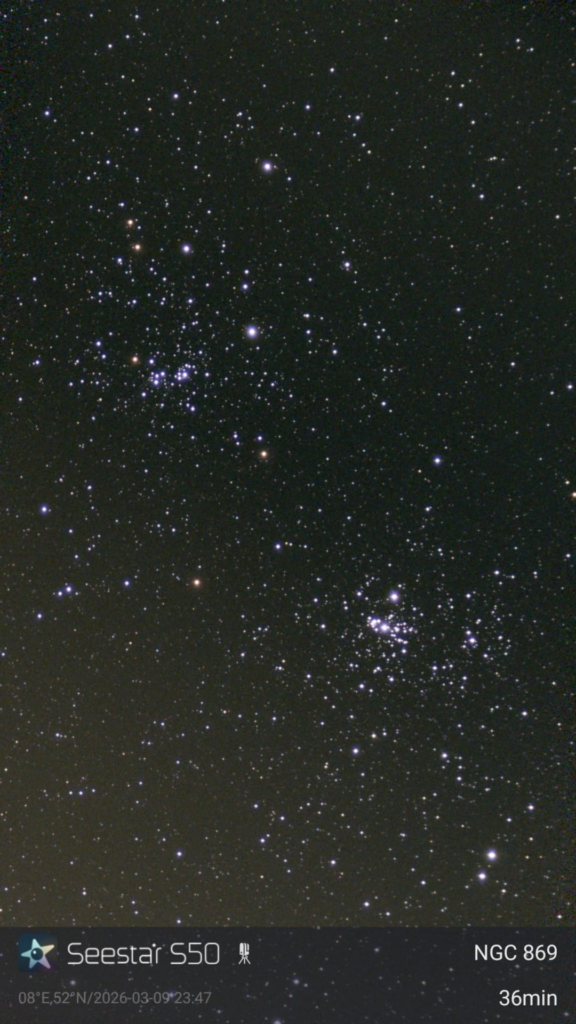
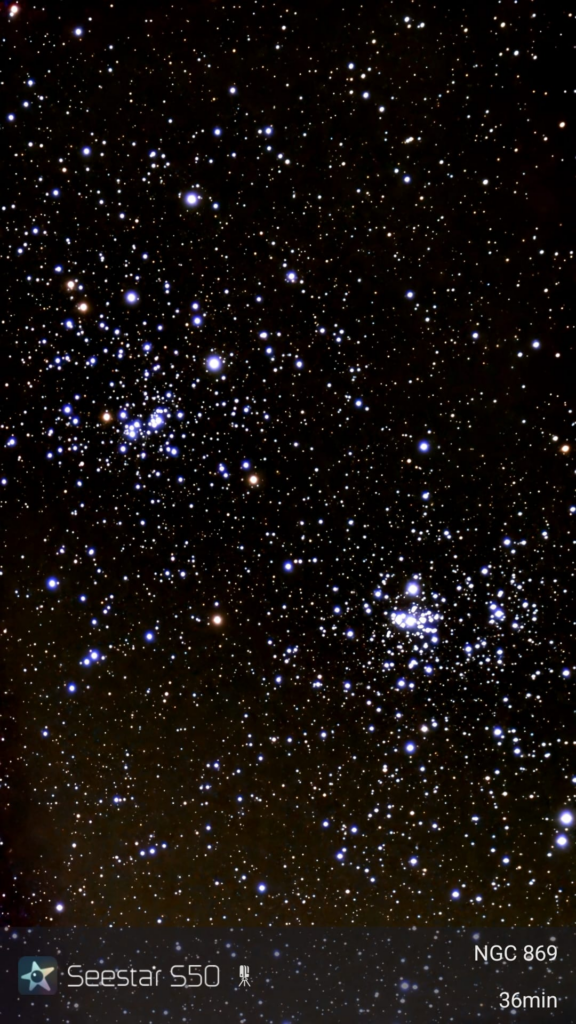
How much exposure time with the Seestar S50 is required for a certain object is revealed, for example, by Google [1]. I then exposed for 36 minutes. The open star cluster h and χ Persei for example was only 30 degrees above horizon.
Finally, briefly regarding my experiences regarding the post-processing of the recordings. At the beginning, post-processing was largely dispensed with. The results were unsatisfactory. This was followed by an experiment with Siril (free image processing software for calibrating, aligning and stacking astronomical images). That was actually a good success. However, the familiarization with the program takes time, and the hardware requirements for fast work are already quite high. So when I took a look at h und χ Persei limited to the tools provided by the Seestar S50 ("Stacking" as well as "AI denoise" as well as settings for brightness, contrast, saturation and image cropping), and I am quite satisfied with the result.
The device gives me a lot of pleasure and I am already looking forward to the next clear nights. I can only recommend the small smart telescope to anyone interested in astronomy who wants to take pictures of nebulae, star clusters, moon or sun – only for planets the focal length is a bit too small, but everything is not possible with one device... but there is hardly any more to be wanted for the money.
[1] Google recommendations for exposure time of h and chi Persei
„For the star cluster h and chi (NGC 869 & NGC 884) h und chi Persei with the ZWO Seestar S50 the following is recommended:
- Minimum exposure time: Already after 15 to 20 minutes total exposure time you get a very respectable image, because open star clusters are very bright compared to faint nebulae.
- Optimal exposure time: Exposure of about 30 to 40 minutes is ideal for bringing out the star colors (especially the reddish supergiants) well and to significantly reduce the image noise in the background.
- Sub exposures:
- Use 10 sencond exposures as single frames.This minimizes faulty frames due to wind or guiding mistakes.
- If you leveld the Seestar S50 perfectly you can go up to 20 seconds to increase efficiency. 20 Sekunden .
Why not longer?
With star clusters, a "saturation effect" occurs more quickly. Too long exposure times (over 60 minutes) often no longer bring any visible detail gain, as the stars can only appear brighter ("burnt out") instead of showing more structure. In addition, the field rotation of the azimuthal system in the Seestar limits the usable image area during very long sessions."
Literature I used:
Astrofotografie leicht gemacht – Die Smartscopes Seestar S 50 und S 30 in „Sterne und Weltraum“ in issue 3/2026
Smart-Teleskope – Verblüffend tiefer Blick ins Universum
in „Sterne und Weltraum“ in issue 4/2026
