A small, turquoise blue spot at the edge of the picture arouses our curiosity
A little detective story by Olaf Homeier and Dr. Achim Tegeler October 11, 2026
Astrophotos by Olaf Homeier
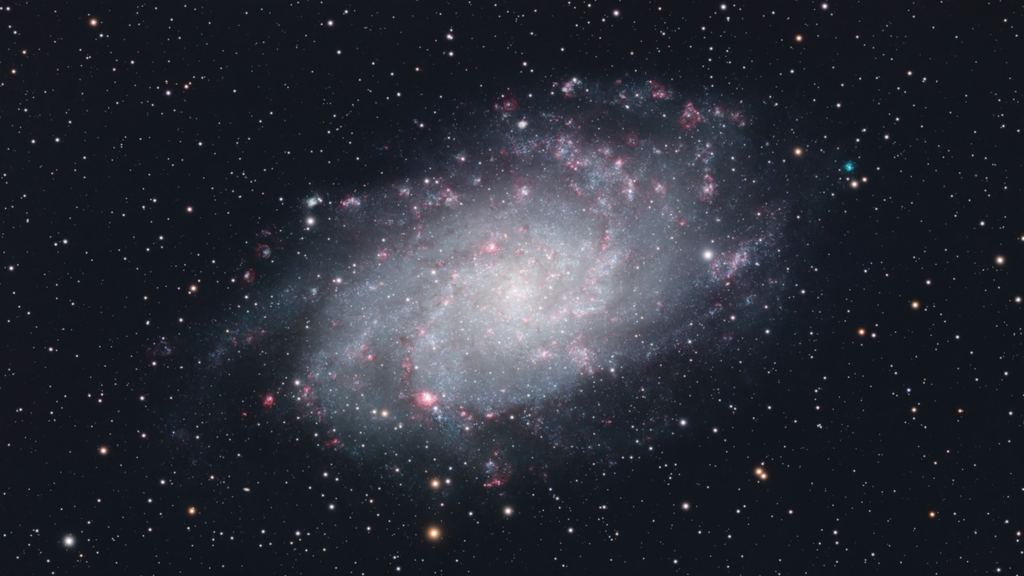
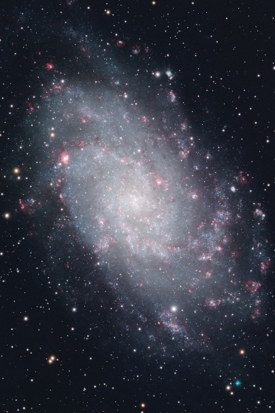
At the beginning of autumn 2026, this image of the galaxy with the number 33 in Charles Messier's famous catalogue was taken [1] . Nothing unusual in itself among our amateur astronomers, and yet the image triggered an intensive search operation with many findings. Why is that? Well, in the photo you can see a small turquoise blue spot on the right edge of the galaxy, which is "a bit out of the ordinary".
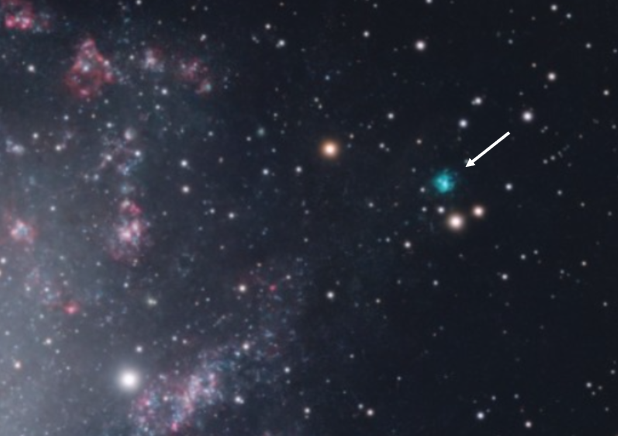
We would therefore like to introduce the galaxy M33 in general and the turquoise blue spot in particular in more detail with this article.
There are vague indications that the galaxy was discovered as early as 1654 by a follower of Galileo Galilei, the Italian astronomer Giovanni Battista Hodierna. However, the history of documented findings about M33 does not begin until 1764. On the night of August 25 to 26 of this year, the French astronomer Charles Messier observed a foggy-looking spot in the constellation Triangle while searching for comets.
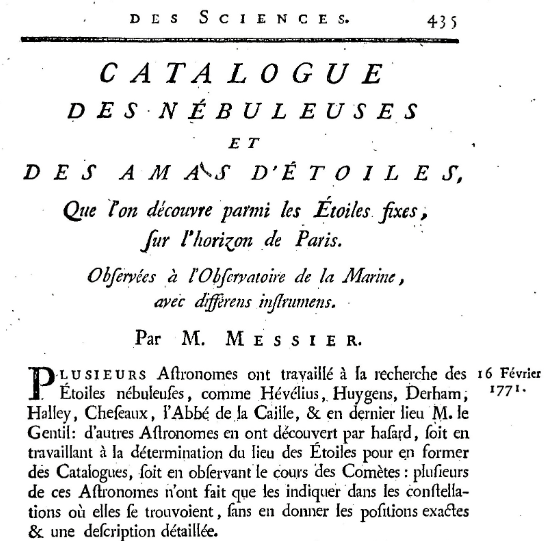
He included it in 1771 under number 33 in the first edition of his famous "Catalogue of Nebulae and Star Clusters", published in 1774, today commonly known as the Messier Catalogue. The galaxy is therefore called M33; in German, the name Triangular Galaxy (after the above-mentioned constellation) has prevailed.
M33 is the third largest galaxy in the so-called Local Group of galaxies in "our corner" of the Universe, after the Andromeda Galaxy and our Milky Way. It has a diameter of about 55,000 to 60,000 light-years (LJ) and contains an estimated 40 billion stars (Milky Way: diameter about 100,000 LJ with about 100 to 400 billion stars, Andromeda Galaxy: diameter 140,000 LJ and maybe 1 trillion stars). All three galaxies are spiral galaxies, but are typed differently in astronomical experts according to the Hubble Classification [2]:
The Andromeda Galaxy fulfills the idea of an "exemplary" spiral galaxy, with a large bright core and tightly wound spiral arms (type SA(s)b). The Milky Way, on the other hand, is a barred spiral with a medium-sized core and wider spiral arms (type SBbc). Finally, the triangular galaxy has a spiral shape without bars, with a small core and with loosely winding, fibrous-looking spiral arms (type SA(s)cd).
The distance from our Earth to the triangular galaxy M33 is generally given as about 2.7 million LJ, while the Andromeda galaxy is our closest large neighbor with a distance of "only" 2.5 million LJ. The light of the galaxies, as we see it today, was therefore created at a time when the first early humans of the genus Homo walked through the savannahs in Africa. So much for the data, now back to the image of the triangular galaxy.
In the image, many pink spots can be seen, which are distributed over the spiral arms and reach to the outermost edge of the galaxy. These are hydrogen clouds in which new stars are formed, whose radiation causes the gas to glow. But wait, why does gas glow at all? Hydrogen is actually an invisible gas.
The solution lies in the absorption of energy:
If enough energy is supplied to a gas, it begins to glow. Everyone knows this from neon signs, in which electric current makes the gas glow red, or from the old orange-yellow sodium street lamps. Each gas glows in its very own, typical colors, like a fingerprint [3]. In space, the young, hot stars take on the role of energy supply: their high-energy UV radiation makes the surrounding gas glow.
And how does it work? If a sufficiently high-energy UV light particle (photon) from a star hits a hydrogen atom, it can knock out its only electron. What remains is a "naked" proton, the ionized hydrogen, also called H II. Therefore, these gas regions are called H II regions. Sooner or later, a proton captures a free electron again, often first on a shell far out (whereby the "shells" represent only a mental model [4]). The electron then jumps inwards step by step (to smaller and smaller energy levels), and with each jump a photon with the precisely defined energy is released. The jump from the third to the second shell produces the deep red H-alpha light at about 656.3 nm, the jump from the fourth to the second the weaker, blue-green H-beta light at about 486.1 nm. Together, they give the typical pink hue in color photos. An "outlier" is the turquoise blue spot on the right edge of the galaxy shown above. It also shows a star-forming region and bears the designation MA 1. How we came up with it was a little detective story. The planetarium program WorldWideTelescope refers to the spot as "IC 137", but that didn't fit, because IC 137 is much closer to the center of the galaxy. Only the exact measurement of the celestial position and a query in the astronomical database SIMBAD brought the solution:
MA 1, named after the astronomers Mayall and Aller, who listed the nebula as number 1 on their list in 1942 [5]. Because it is not in any of the classic catalogs, hardly any planetarium program knows it. In addition to hydrogen, the gas there contains traces of oxygen that previous generations of stars have incubated. However, MA 1 contains several so-called Wolf-Rayet stars [6], which are among the hottest stars known. Their radiation is so energetic that it snatches two electrons from the oxygen atoms. This doubly ionized oxygen glows blue-green and gives MA 1 its turquoise color (500.7 nm).
In the other hydrogen clouds, such extremely hot stars are usually absent, which is why the oxygen present there shines much weaker and is covered by hydrogen light. The question remains as to why the nebula area MA 1 now glows so beautifully intense turquoise blue in the image above, much more clearly than it could ever be seen with the naked eye at the telescope.
To do this, you can take a look at two common methods of astrophotography: photography with color cameras, so-called OSC (one-shot color) cameras, and with monochrome cameras. In color cameras, each individual pixel on the sensor is covered with a tiny color filter, in a fixed pattern of red, green, and blue (the so-called Bayer matrix). This means that all three primary colors are captured simultaneously with a single image and then processed into a color image. Monochrome cameras do not have such filters on the sensor; they only measure how much light arrives for each pixel. A color image is only created when you photograph successively through different filters that turn a filter wheel in front of the sensor. The individual images are then combined on the computer to form a color image. In order to capture the light of individual elements in a targeted manner, monochrome cameras can use so-called narrowband filters. They only allow a very narrow range of the spectrum to pass through, such as the deep red H-alpha light of hydrogen or the blue-green light of doubly ionized oxygen. All other light components are blocked and do not reach the sensor. For our image, in addition to the normal color images, only hydrogen and oxygen light were collected for two and a half hours each, and both were included in the color image. The weak oxygen glow of MA 1, which would hardly be noticeable in a normal color image, is thus clearly visible. And the turquoise is not a fantasy color: the oxygen light is actually in the blue-green range. Color cameras can also capture such narrowband data, but with limitations. For this purpose, there are so-called dual-narrowband filters, which only allow light from the hydrogen and oxygen lines to pass through. Due to the Bayer matrix, however, the red H-alpha light is only captured by every fourth pixel, so that a large part of the resolution and sensitivity is lost.
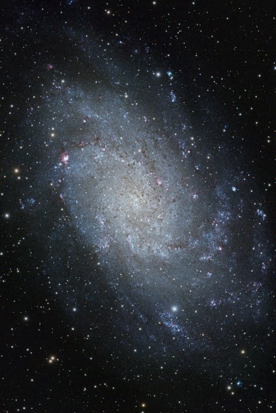
So a small, colorful spot at the edge of the picture becomes a nice detective story at the end.
For us, MA 1 simply shows how much fun it is to take a closer look at your own images. You don't have to revolutionize astronomy right away – it's just a pleasure to understand what you've actually captured in space. And the next time we look at M33, we now know exactly why it glows so uncharacteristically turquoise out there at the edge.
Sources and information:
[1] Messier catalogue: https://archive.is/Rh9Y3
[2] Hubble classification of galaxies https://en.wikipedia.org/wiki/Hubble_sequence
[3] Robert Bunsen (chemist) and Gustav Kirchhoff (physicist) worked together at the University of Heidelberg from 1859 onwards and jointly founded spectral analysis. They found that each chemical element emits a characteristic spectrum of light when heated. -> also spectroscopy https://en.wikipedia.org/wiki/Spectroscopy
[4] Shell model according to Niels Bohr https://de.wikipedia.org/wiki/Schalenmodell_(Atomphysik)
[5] In: The Rotation of the Spiral Nebula Messier 33, Mayall, N. U. & Aller, L. H., 1942, Astrophysical Journal, Vol. 95, S. 5–23 https://articles.adsabs.harvard.edu/pdf/1942ApJ….95….5M
[6] Wolf-Rayet-stars https://en.wikipedia.org/wiki/WolfRayet_star
[7] Kehrig et al. „Gemini GMOS spectroscopy of HeII nebulae in M 33“, A&A 526, A128 (2011) https://www.aanda.org/articles/aa/pdf/2011/02/aa15493-10.pdf
