Article by Dr. Gerold Holtkamp, April 24, 2026
There is an update , September 9, 2026
This paper describes the measurement of the transit light curve of the exoplanet TOI-1859b from April 7th to 8th, 2026. The result shows a significant deviation from the predicted transit times. Comparison with other light curves recorded on the same night by other authors shows that this is not due to a measurement error.
The Observation Object
TOI-1859b was discovered in 2023. From Earth, it is located in the constellation Draco, 727 light-years away. It has 0.87 times the radius of Jupiter and orbits its parent star in a highly elliptical path (eccentricity 0.6) with a semi-major axis of 51 million km. Its parent star is of spectral type F7V, has 1.3 times the mass of the Sun, 1.4 times the radius of the Sun, and a surface temperature of 6300 °C. A companion star of spectral type M is also believed to exist. [1].
When the Exoclock project proposed the exoplanet TOI-1859b as a suitable observation target for April 7, 2026, I wanted to take on this quite challenging task [2]. Finally, the expected dip in the brightness of the parent star was very small at 5.35 mmag. However, this planet had a unique feature: an exceptionally long orbital period – the longest I've ever observed – of 63.4 days. Within the Exoclock project, apart from the measurements taken by the TESS spacecraft, there were no ground-based measurements of the transit light curve. This, of course, made it even more intriguing.
The Measurement
The night was clear. The moon had 69% illumination and was 98° away from the star TOI-1859. It rose at 2:54 a.m. CEST and set at 9:13 a.m. CEST. At its meridian transit at 6:04 a.m. CEST, it was only 8.7° above the horizon. Therefore, it likely had no influence on the measurement [3].
The transit times specified by the Exoclock project for my observation site in Osnabrück were [4]:
Start: 11:51 PM CEST (11:54 PM)
Midtransit: 2:15 a.m. CEST (2:37)
End: 4:39 a.m. CEST (5:21)
(The times in parentheses are from the transit finder of the US-American Swarthmore College) [5])
The transit duration of 4.8 hours, together with the one-hour plateau measurements before and after the end of the transit, resulted in a total measurement duration of 6.8 hours.
A Skywatcher Newtonian telescope with a 305 mm aperture and 1200 mm focal length was used. 275 images were taken with the QHY268M monocular camera. An Antlia red filter was used. The exposure time was 90 seconds.
The adjustment of the recordings with the associated dark, flat, flatdark and bias recordings was done using the HOPS software from the Exoclock project. [6].
Discussion of the result
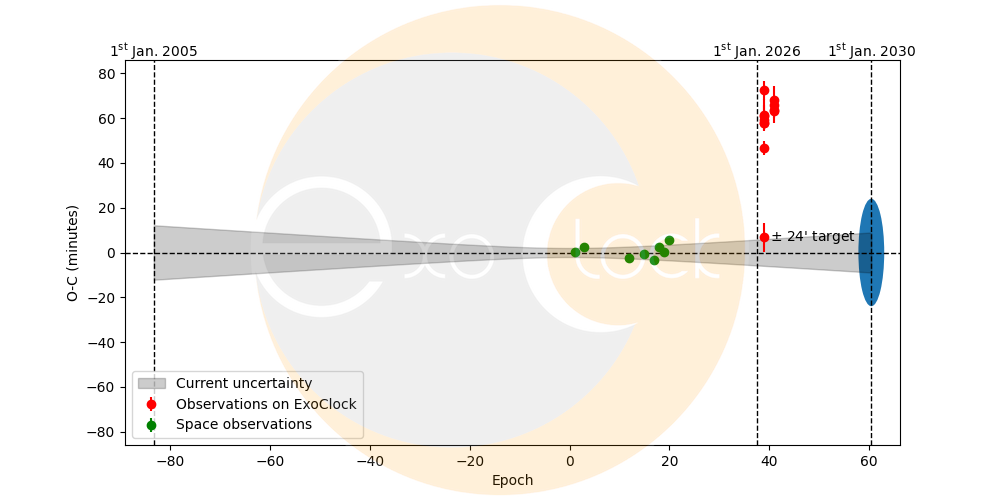
I uploaded the collected measurement data to the Exoclock homepage. There, it was analyzed and evaluated. At that time, there was only one other measurement from the same night. This measurement accurately predicted the start, middle, and end of the TOI-1859b transfer. In contrast, my measurement showed transfer times 61 minutes behind the predicted values!
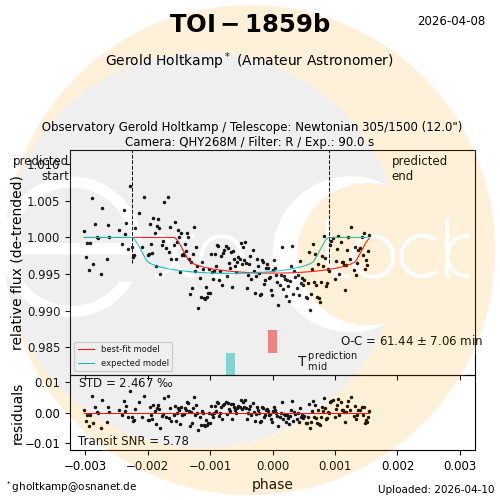
It took about a day for further measurements from the same night to arrive on Exoclock. These, however, confirmed my measured deviation!
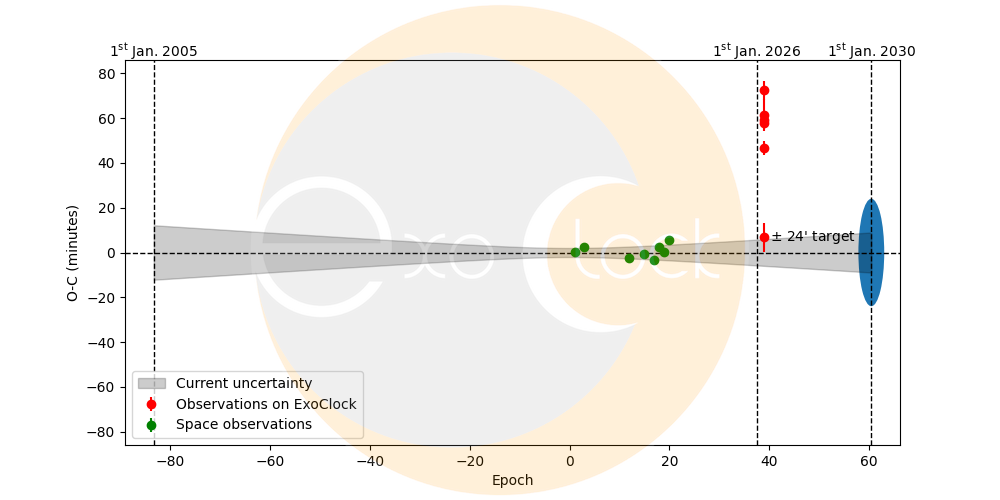
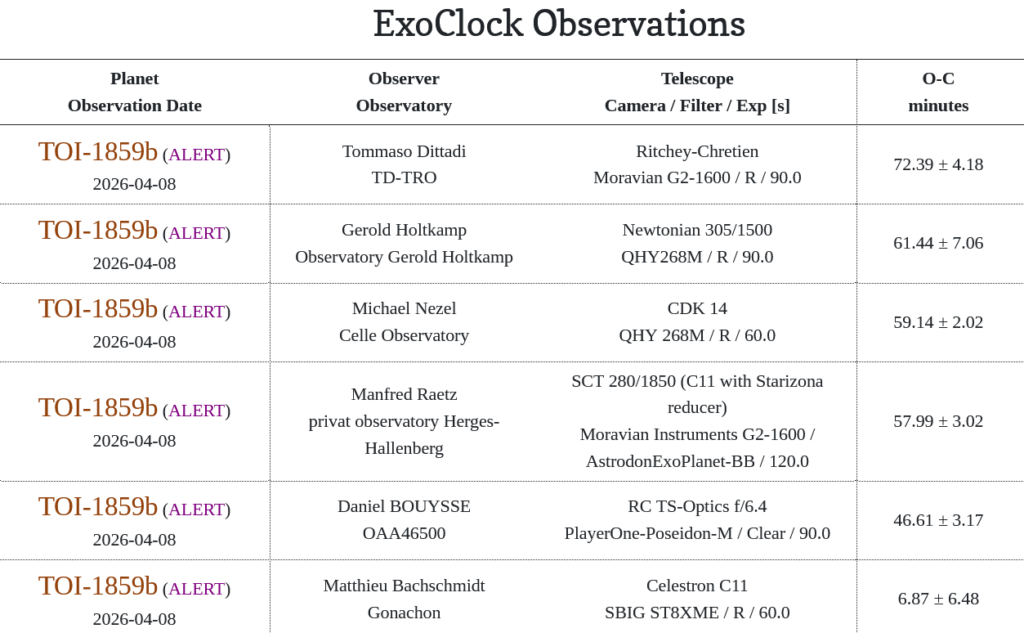
Initially, I suspected a problem with the conversion from CEST to UTC, both on my end and later in the Exoclock project. However, the transit finder mentioned above shows almost the same start time (+3 minutes). Nevertheless, the midpoint of the transit differs by +22 minutes and the end of the transit by +42 minutes. This could indicate different source data or different calculation methods.
Another possibility, however, is that something happened in the system of the star TOI-1859 that caused this change. This significant deviation from the transit data taken from the literature prompted the exoclock team to immediately change the status of TOI-1859b from "High" to "Alert." This means that further measurements are urgently needed to verify this result. These transit times are intended to enable precise planning of observation times for the Ariel satellite planned for 2030 [9]. A one-hour deviation would be a very costly deviation for this space-based exoplanet observation program.
Update, September 9, 2026
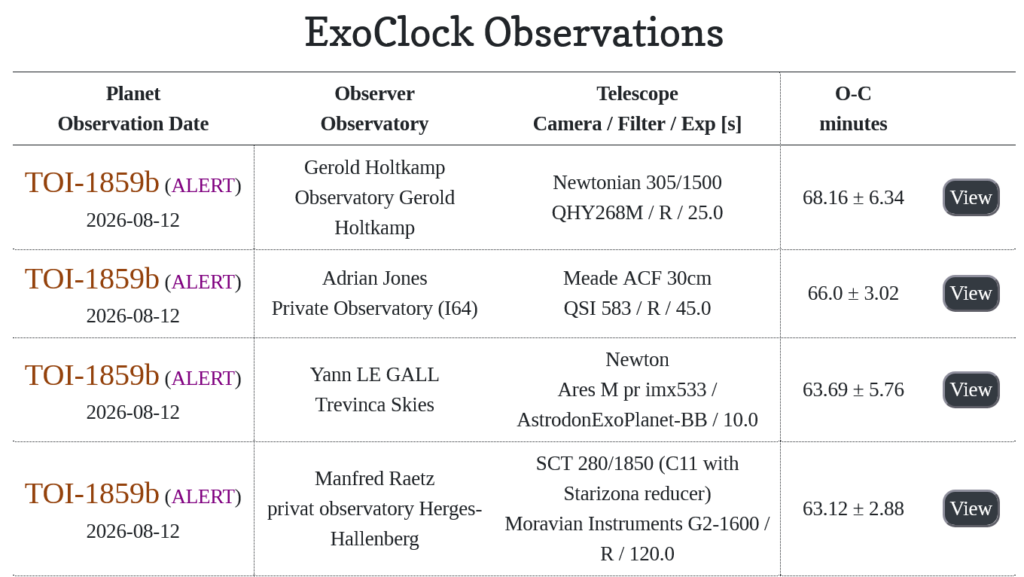
Due to the exoplanet TOI-1859b’s long orbital period of 63.4 days, there are relatively few opportunities to observe a transit. The transit on June 9, 2026, could not be observed from Europe because it occurred during daylight hours. However, I was able to capture another transit light curve during the night of August 12–13, 2026. Once again, an "outlier" appeared relative to the expected transit time. Three other ExoClock members also measured this same deviation.
________________________________________________________
[1] https://exoplanet.eu/catalog/toi_1859_ab–8681/
[2] https://www.exoclock.space
[3] https://www.timeanddate.de/mond/deutschland/osnabrueck
[4] https://www.exoclock.space
[5] https://astro.swarthmore.edu/transits/
[6] https://www.exoworldsspies.com/en/software/
[7] https://www.exoclock.space/database/observations/TOI-1859b_151_2026-04-08_Gerold_3251_R/
