Report on the construction of a moon phase model for the visualization of the different moon phases and their formation
Olaf Homeier, September 2026
The moon appears in the sky in different forms over the course of a month: once as a crescent shape, then a crescent moon and finally a full moon. Then again a crescent moon, crescent moon and finally a new moon. How do you explain the formation of these moon phases to someone who is interested?
At our Sternstunden we usually use a flashlight as a sun and illuminate a ball as a moon that you carry around in a circle. Depending on the location, you can then see the phases of the moon ... depending on the location? That's the catch: If you stand outside the circle, you always see the half-illuminated moon. Only if you stand inside the circle (on the Earth's position) do you perceive the moon phases.
Therefore, the idea arose to build a model that allows the viewer to experience the view from Earth. Here are my ideas/specifications:
- it should be a "small" model, as portable as possible, so that it can be easily transported
- the viewer should be able to see the model as a whole, but also the "earth view"
- a small, slow-running DC motor spins a ping-pong ball (= moon) on a small pole in a circle
- a small camera is mounted on the motor axle that looks at the moon
- the camera is thus in the position of an observer on Earth
- the live image from the camera is transmitted to a screen at the edge of the model
- from one side of the model box, LEDs illuminate the table tennis ball moon
- the model should be able to control fixed positions (= moon phases) (full moon, crescent moon, quarter moon, new moon)
- the viewer should be able to interact via some buttons
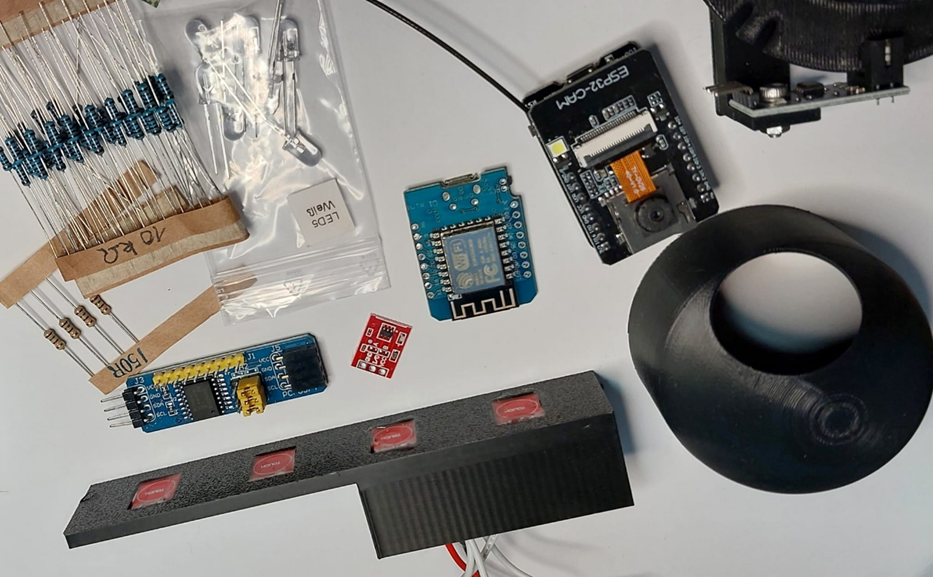
After intensive research and many attempts, this variant was then executed:
Take an ESP32 camera. It is small, programmable and can transmit the image via WLAN. In addition, a matching LCD screen with ESP32, which receives and displays the image via WLAN.
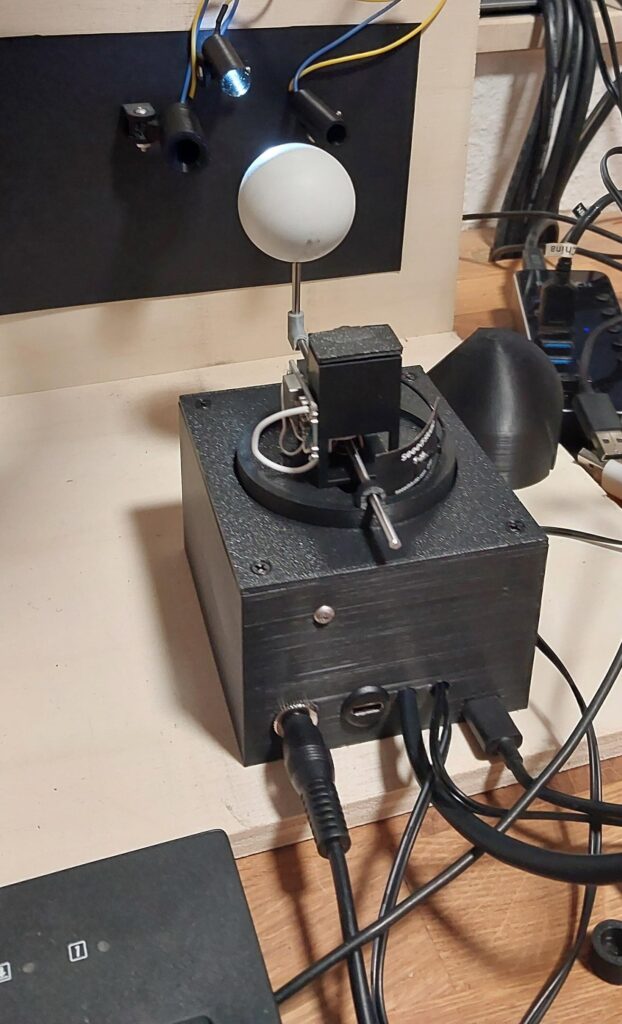
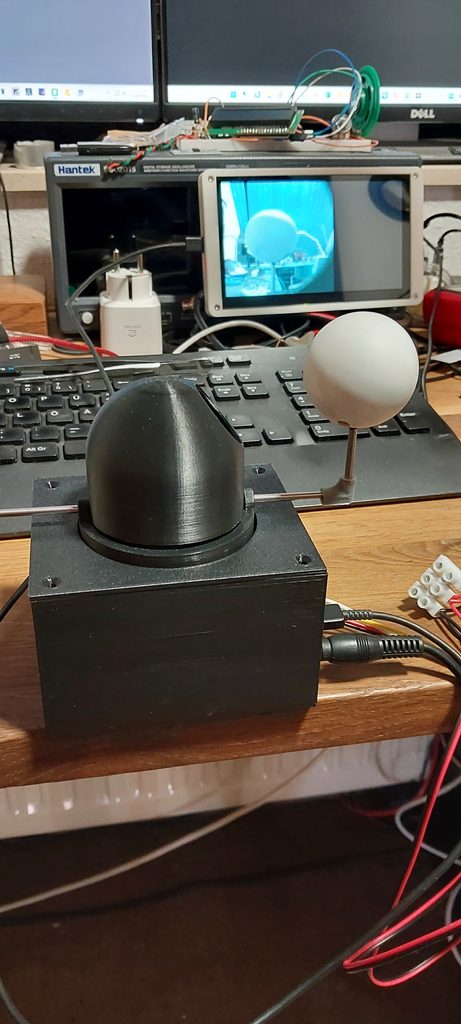
The control center will be a ESP8266 (Wemos D1) microcontroller, which is also WLAN-capable. It controls the DC motor, determines the position of the table tennis ball moon, transmits the information to the screen via WLAN and accepts the viewer's button commands.
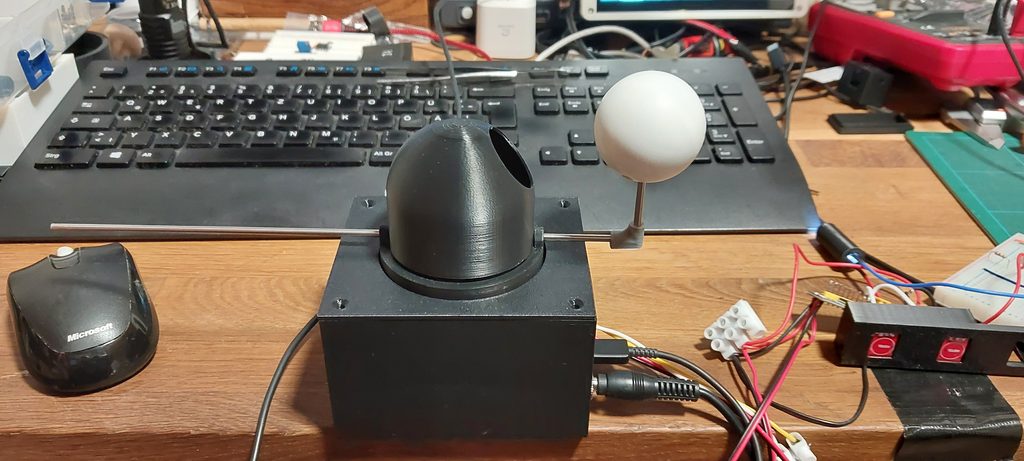
To detect the current position of the table tennis ball moon, a disc with slots is attached to the motor axle, which reports the positions to the ESP8266 by means of a small light barrier.
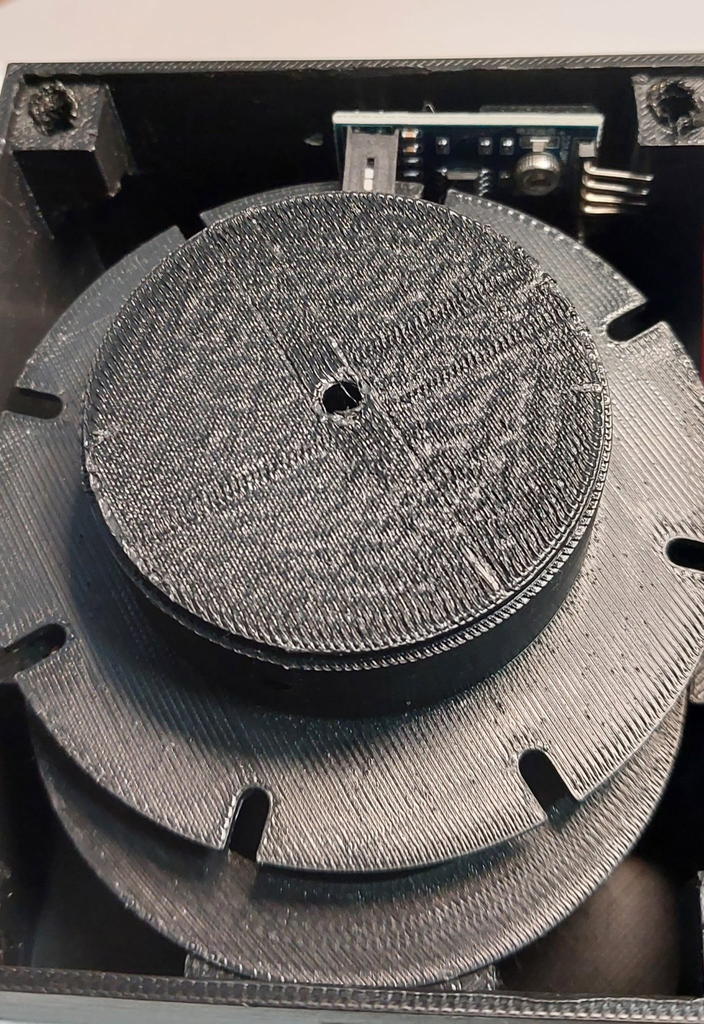
The whole thing was installed in a box cube made of plywood panels with an edge length of 30 cm. One side is replaced by an acrylic glass pane, so that you can look at the model "innards" from the outside. The buttons and the screen are also located on the pane.
The first use of the model has already been successfully carried out in our kosmos-os exhibition in the think tank of the Museum Industriekultur Osnabrück.
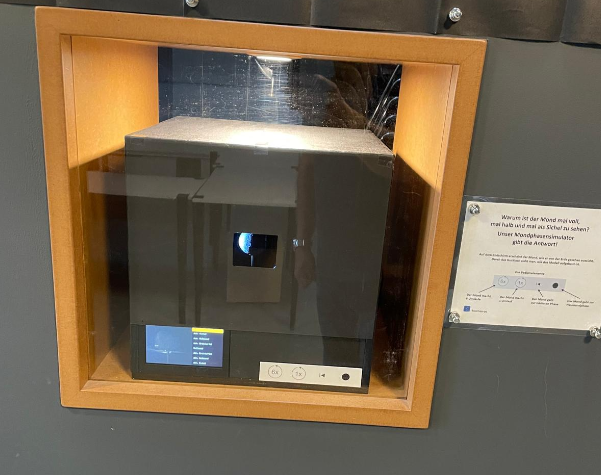
Also at our booth of the Bürgerfest at the Ledenhof in Osnabrück the model will be on display again.
