Why we can't observe the lunar rover from Earth!
A short summary by Dr. Achim Tegeler, October 2026
During our Sternstunden we usually set up different types of telescopes with which we observe the celestial objects. We are often asked how much the magnification of the devices is and whether we could not see the vehicles left behind on the moon by the Apollo missions of the J-type (Apollo 15, 16 and 17) [1]. A good idea, actually, since small objects are magnified in the telescope. But it's not quite that simple.
The magnification of telescopes is variable and not their primary purpose. Telescopes are primarily intended to collect light and thus make it possible to show two closely spaced objects or points as two separate objects by increasing contrast and not allowing them to "blur" into each other.
This is the big challenge for very distant objects (which are therefore very close together when viewed from a great distance
The further away two objects are from the observer, the smaller the angle between them (the angle of view) that still needs to be resolved. And this is exactly what telescopes are particularly good at - always depending on the aperture.
Among other physicists, William Rutter Dawes (1799-1868) [2] and later John William Strutt 3. Lord Rayleigh (1842-1919) [3] dealt with the resolving power of optics and developed an approximate (heuristic) approach to description.
Here we look at the Rayleigh criterion [4], which shows the relationship between the aperture of a telescope and the resolving power [5].
Between 1879 and 1880 [6], Strutt considered the wave character of light and described the distance at which two light sources that are close together are still perceived as two separate objects: Light passing through an optical system produces diffraction (or Airy) disks [7].
In contrast to geometric optics, this property leads to a (diffraction) limited resolving power. In this case, the Rayleigh criterion applies:
"Two points are resolved as such if the (intensity) maximum of one diffraction disc coincides with the first (intensity) minimum of the other diffraction disc."
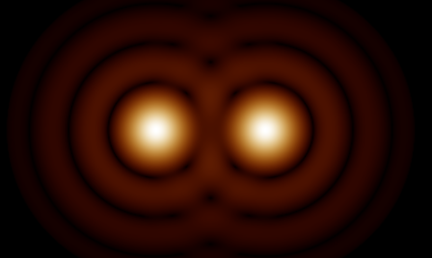
This can also be solved mathematically, because the angular distance α the first minimum is defined as follows, depending on the wavelength:
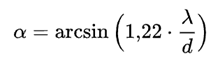
Where λ is the wavelength of the light and d is the aperture of the telescope
Because the ratio of wavelength λ in the nanometer range to the optical aperture d in the centimeter range yields extremely small values close to 0, you can also calculate approximately without the arcsine (arcsin) (small-angle approximation [8]). Therefore, this can also be written as the following formula:

We now use this formula for our calculation of the necessary aperture of a telescope to observe the 3.1 m long lunar rover on the Moon:
To do this, we simply change the formula and solve for d (the diameter of the telescope):
α = 1,22 · λ /d
d = 1,22 · λ /α or
d = 1,22 · λ /(l/s) = d = 1,22 · λ s/l
where α (alpha) is the angle (in rad) at which we see the object. It is derived from the ratio of object size to the observation distance, i.e. object size l / distance s
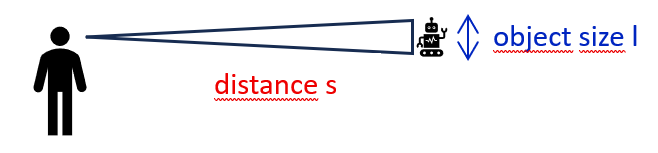
- How large does the aperture of the telescope have to be to be able to observe a certain object at a certain distance?
The initial data
Earth-Moon observation distance (averaged) in meters
s=384.400 km = 384.400.000 m
Wavelength of light (people see best in green) in meters
λ=550nm = 0,00000055 m
Objects size (LRV Moon Rover) im meter l=3,1 m
Angle of view or angular distance α = object size l / observation distance s
α = 3,1 m/384.400.000 m = 0,000000008065
The aperture of such optics would therefore have to be:
d= 1,22 · 0,00000055 m/0,000000008065= 83,20 m !
However, an optical telescope with such a diameter does not exist – even the Hubble Space Telescope with its 2.4 m diameter mirror would not be able to image the lunar rover.
- What size object can I resolve with my telescope at a certain distance?
However, we can also use this Rayleigh criterion to determine what size of object we could still detect on the Moon (or at another distance). To do this, we simply change the formula to l and specify the telescope diameter d (e.g. 20 cm):
d= 1,22 · λ s/l -> l = 1,22 · λ s/d
l = 1,22 · 0,00000055m · 384.000.000m/0,2m = 1289 m
With a telescope with an aperture of 20 cm, we could still resolve objects on the moon that are 1289 m in size.
To calculate such data for the Rayleigh criterion, I have always used a classic Excel spreadsheet so far, old-fashioned as I am. In this I can enter the respective data and get the result back according to the formula mentioned above. So I can work through both solutions shown.
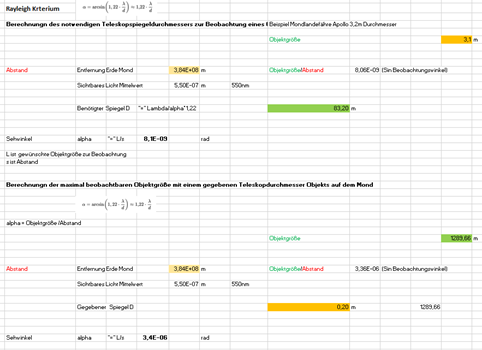
But now, thanks to the help of Olaf Homeier, kosmos-os has developed its own tool to solve these tasks, which we now make available to anyone interested on our website.
You can find it here: Rayleigh criterion calculator
Sources and information:
[1] J-type Apollo missions https://en.wikipedia.org/wiki/List_of_Apollo_missions
[2] William Rutter Dawes https://en.wikipedia.org/wiki/William_Rutter_Dawes
[3] John William Strutt 3. Lord Rayleigh https://en.wikipedia.org/wiki/John_William_Strutt,_3rd_Baron_Rayleigh
[4] Rayleigh criterion https://en.wikipedia.org/wiki/Angular_resolution#Explanation
[5] Angular resolution https://en.wikipedia.org/wiki/Angular_resolution
[6] Original paper by Lord Rayleigh https://zenodo.org/record/1431143/files/article.pdf
[7] Diffraction disks https://en.wikipedia.org/wiki/Airy_disk
[8] Small-angle_approximation https://en.wikipedia.org/wiki/Small-angle_approximation
